




News and stories
All stories
Stories that highlight the people and programs making healthcare more accessible across Oregon.
Company highlights
The innovative programming and achievements that reflect our commitment to quality care.
CareOregon culture
A look inside the people and values that make CareOregon a compassionate workplace.
Community impact
Partnerships and programs that strengthen health and wellbeing across Oregon communities.
Health and wellness
Tips and insights to support physical and emotional wellbeing for our members.
Building capacity where care begins: PHLOW and Jackson Care Connect are transforming mental health access in Southern Oregon
Published June 26, 2026
-
 Copy link
 -
 Share on Facebook
 -
 Share on Bluesky
 -
 Share on X
 -
 Share on LinkedIn
- partnerships
As Oregon confronts a compounding mental health crisis alongside persistent workforce shortages, innovative, community-rooted solutions are urgently needed — particularly in Medicaid. One potent solution is PHLOW (Psychiatric Health, Life Skills and Opportunities for Wellness), a primary-care-embedded psychiatric consultation model developed by La Clinica — a Federally Qualified Health Center in Southern Oregon — and made possible through sustained investment from Jackson Care Connect (JCC).
“By embedding psychiatric expertise directly into primary care, PHLOW is changing how, and where, mental health care is delivered,” said Julia Jackson, Director of Behavioral Health at JCC. The program reduces unnecessary referrals to specialty psychiatry, improves patient outcomes, strengthens provider confidence and may lower the cost of mental health claims by over 50% per member per month, based on preliminary observations of financial trends. In 2025, primary care physician (PCP) residents had in-person access to curbside psychiatric consultation and shared visits for 200 hours. “PHLOW’s success offers a powerful example of what proactive Medicaid investment looks like in action — and a model other communities can learn from,” Jackson added.
Meeting patients where they already are
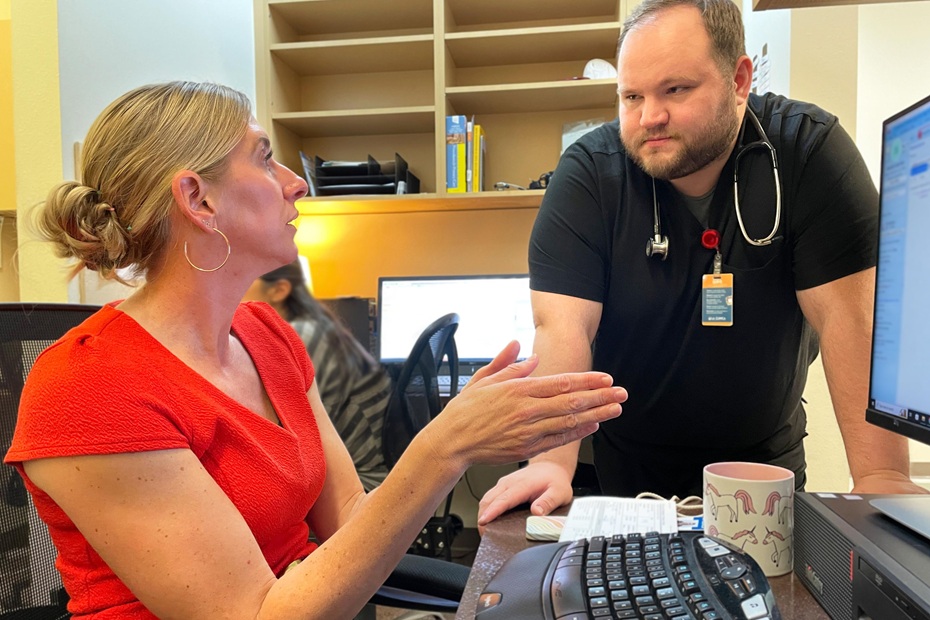
PHLOW operates on a simple but transformative premise: Many behavioral health needs can be effectively addressed within primary care when PCPs and behavioral health clinicians are supported with timely psychiatric consultation. Rather than defaulting to long waitlists or emergency referrals, primary care providers can access real-time psychiatric expertise to clarify diagnoses, guide medication decisions and determine the appropriate level of care.
“The goal of the PHLOW program is to deliver team-based, integrated psychiatric care in the least restrictive, most patient-centered setting — the primary care environment,” said Rosa Ruggiero, Psychiatric Services Director at La Clinica. “This approach increases the primary care team’s capacity while ensuring specialty mental health resources are reserved for those who need them most.”
PHLOW’s consult-first model has three components: psychiatric consultation, short-term episodes of direct psychiatric care when clinically indicated, and behavioral health education for health care providers. Together, these elements help primary care teams safely manage mild to moderate conditions — and even many complex issues — without over-reliance on scarce specialty services.
Real-world impact for patients and providers
Clinical vignettes illustrate what this looks like in practice.
In one case, a pediatrician consulted a psychiatry provider via PHLOW about a 17-year-old experiencing anxiety, depression and possible hallucinations related to trauma. With psychiatric guidance, the provider was able to distinguish trauma-related symptoms from psychosis, adjust medication appropriately, and reassure the family — preventing emergency department visits and unnecessary referrals. When the adolescent later required a formal psychiatric evaluation, PHLOW provided rapid access and then stepped care back down to pediatrics as symptoms improved.
In another case, a 68-year-old woman with schizophrenia and type 1 diabetes was able to manage both complex conditions within primary care, supported by PHLOW consultation and La Clinica’s clinical pharmacy team. With careful medication guidance and shared decision-making, her paranoia resolved, her quality of life improved, and she avoided both emergency care and long-term specialty psychiatry. This meant she could remain in the setting where she felt most comfortable.
Elizabeth Banowetz, MD, is Medical Director at La Clinica’s Birch Grove Health Center and a family medicine physician. She can attest firsthand to using PHLOW in her own practice. “Through regular consultation with PHLOW psychiatry providers, I have been able to more confidently and effectively manage complex mental health conditions within primary care,” she said. It has also helped Birch Grove overall. “Beyond direct patient care, PHLOW has had a lasting impact on our clinic infrastructure,” Dr. Banowetz added. “It improves access, quality, provider skills and clinic sustainability, and I see it as an essential model for integrated mental health care in primary care settings.”
“These are exactly the kinds of outcomes we aim for,” Ruggiero explained. “PHLOW reduces the risk of patients being unnecessarily labeled as chronically mentally ill and instead emphasizes recovery, resilience and care that fits their actual needs.”
Evidence-based — and now published
In 2025, PHLOW was formally described and evaluated in an observational study published in the medical journal Families, Systems, & Health, establishing it as a replicable, evidence-informed model for integrating psychiatric services into primary care.
The study demonstrates that structured psychiatric consultation improves diagnostic accuracy, supports more appropriate prescribing, and reduces unnecessary referrals to specialty mental health services — without compromising quality of care. Importantly, it also highlights the role of payer-provider collaboration, showing how aligned investment can improve outcomes while promoting responsible resource use.
This publication shows that behavioral health needs can often be addressed effectively in primary care.
Rosa Ruggiero.
As detailed in the study results, in 2023, the PHLOW program served 379 unique patients over 569 consults. Just five of the 379 patients merited a step up in care to specialty community partners. Remarkably, all the other patients remained appropriately cared for in the primary care setting.
“This publication shows that behavioral health needs can often be addressed effectively in primary care,” said Ruggiero. “It also validates the power of partnership — between health systems and Medicaid payers — to build sustainable solutions.”
Medicaid investment that builds systems
PHLOW would not exist without Medicaid funding. JCC’s investment made it possible for La Clinica to develop the program, and the ongoing collaboration has supported growth, evaluation and expansion.
“As a Medicaid insurer serving Southern Oregon, JCC is intentionally investing in innovative, community-driven solutions to the mental-health access crisis — solutions that build better systems rather than temporary stopgaps,” noted Jackson. By funding psychiatric consultation and workforce development, JCC is helping create increased capacity within primary care, where most mental health care already occurs.
This kind of investment is crucial. Traditional fee-for-service psychiatry alone cannot meet current demand, particularly in rural communities. PHLOW demonstrates how Medicaid dollars can be used proactively to expand access, stabilize the workforce and reduce total cost of care over time. “The program supports optimized psychiatric medication management while thoughtfully balancing patients’ physical health needs,” said Banowetz.
For example, when antipsychotic medications contribute to weight gain or diabetes risk, PHLOW allows Birch Grove’s staff to address these tradeoffs proactively and focus on prevention, rather than reacting to complications later.
Change in care delivery is gradual, but meaningful shifts occur over time.
Rosa Ruggiero
In addition, Banowetz noted that her clinic’s PHLOW psychiatry provider has contributed to system-level improvements, including the development of workflows that allow behavioral health clinicians to give the right therapy and keep track of patients who are starting or taking psychiatric medications, as well as the creation of team-based clinical case conferences for patients with difficult or complex behaviors. “These conferences make it possible to continue caring for patients who might otherwise be dismissed from care due to system limitations,” she said.
Looking ahead: Expansion and replication
PHLOW is now expanding into pediatric care, where early intervention can alter lifelong trajectories. At the same time, the program offers lessons for other health organizations facing similar challenges.
“Change in care delivery is gradual, but meaningful shifts occur over time,” Ruggiero said. “Organizations interested in this model should prioritize integrated behavioral health teams supported by psychiatric consultation — and align financing with long-term system outcomes, not just visits.”
As Oregon continues to navigate a complex mental health landscape, PHLOW stands as a clear example of what’s possible when communities invest early, allowing providers to collaborate deeply and build care around patients’ needs.